Your NS Pre-Enlistee Toolkit: The Exit Permit, The $75,000 Bond, and Study Opportunities
TL;DR:
- Any male Singapore citizen or PR, leaving Singapore for more than 3 months needs an Exit Permit, starting from age 13
- After 16.5, you also need a bond that can hit $75,000 or more
- NS doesn’t have to be dead time. There are diploma programmes, 75,000 online courses, and career schemes most guys never touch
- If you’re already thinking about IPPT prep alongside all of this, our IPPT Calculator can show you exactly where you stand.
Here’s a scenario that plays out more often than you’d think.
A family spends months planning their son’s overseas university application. They sort the school shortlist, they prep for the SAT, they even argue about whether Melbourne or London is better. Everything is going smoothly. Then the acceptance letter arrives, and somewhere between the celebration and the packing, someone quietly forgets one thing.
The Exit Permit.
Not because they’re blur. Just because nobody told them it was compulsory. Or that a bond of up to $75,000 might be involved. Or that leaving without one is a criminal offence under the Enlistment Act.
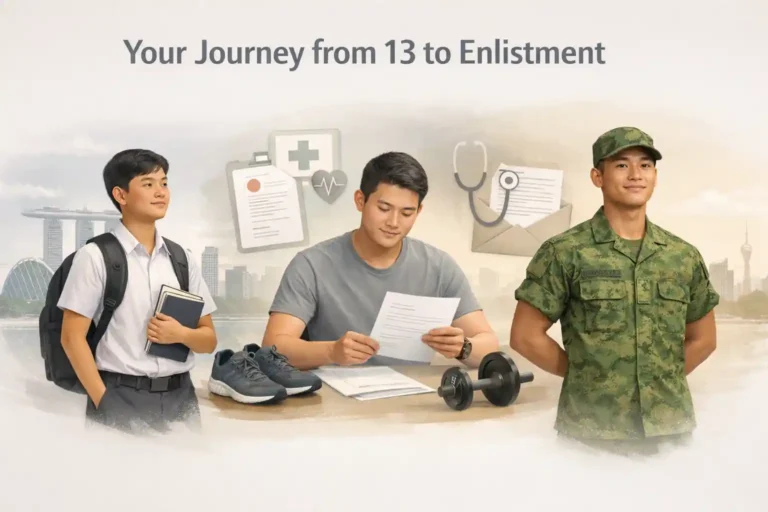
This article covers two things every pre-enlistee and his family needs to know before anything else: how the Exit Permit and bond system actually works, and what learning opportunities are sitting inside NS that most guys completely miss. Both topics are less complicated than they sound. Once someone explains them properly, it all makes sense. By the way if you are interested on what your son’s life go through from now on, read our complete guide from 13 years to enlistment .
The Exit Permit and Who Needs One
An Exit Permit (most people just call it an EP) is basically official permission from the Central Manpower Base (CMPB) to stay overseas for an extended period. Not a tourist visa, not a school application form. Something specific to NS.
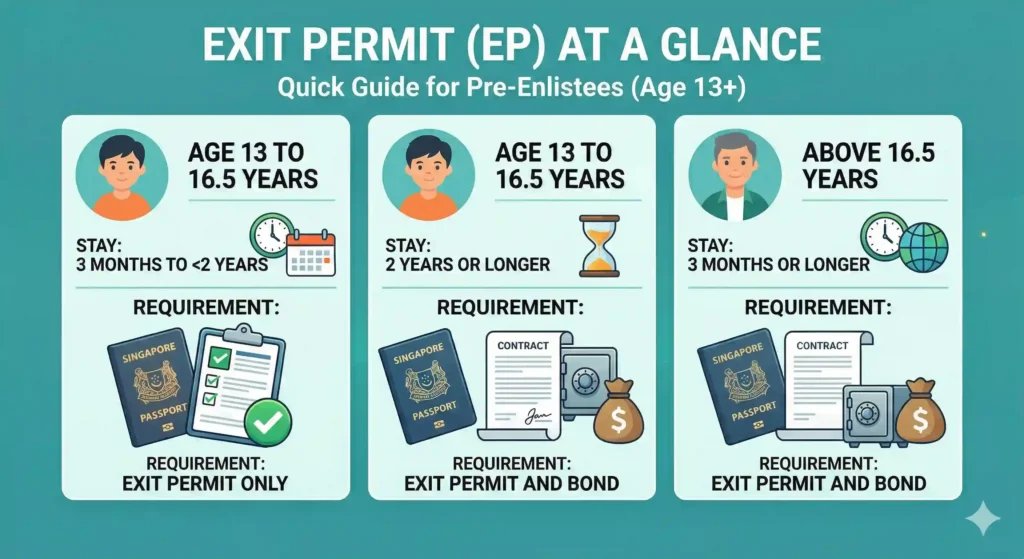
The rule is simple on the surface. If you’re a male Singapore citizen or PR who is 13 years old or above, and you plan to be outside Singapore for more than 3 months, you need an EP. Short holidays, a month-long summer programme, even a 10-week internship: those don’t require anything. It’s the longer stays that trigger the requirement.
Here’s where most families get caught off guard: it starts at 13. Not when NS is near. Not after your O-Levels. The moment your son turns 13, the EP rules apply. CMPB will send a notice to your registered ICA mailing address around that time. If your address isn’t updated, you might miss it entirely.
At a Glance:
Age | Duration Overseas | What’s Required |
|---|---|---|
13 to 16.5 | 3 months to under 2 years | Exit Permit only |
13 to 16.5 | 2 years or longer | Exit Permit + Bond |
Above 16.5 | 3 years or longer | Exit Permit + Bond |
That bond column in the bottom two rows. That’s where things get serious.
The $75,000 Bond: What Nobody Warned You About
Let’s talk about this properly because it catches a lot of families completely off guard.
When your son is above 16.5 years old and plans to stay overseas for 3 months or more, getting an EP alone isn’t enough. CMPB will also require a bond, which is a legal guarantee that he will return to Singapore before the EP expires. If he doesn’t come back in time, the bond gets forfeited. All of it.
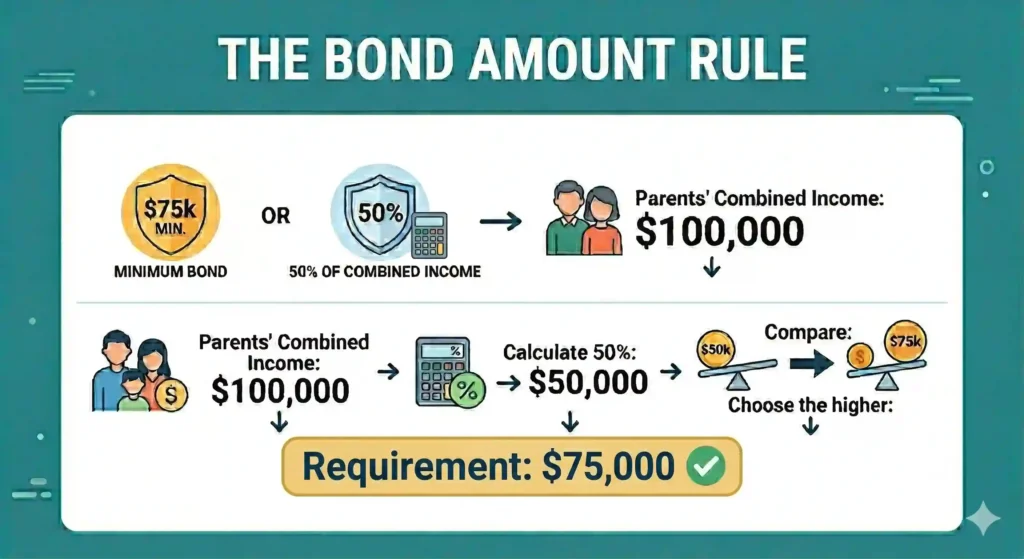
The amount isn’t fixed. It’s calculated based on both parents’ income for the preceding year. Specifically, it’s either $75,000 or 50% of both parents’ combined annual gross income, whichever is higher.
Take a moment with that formula.
To understand it, lets say both parents earn a combined $120,000 a year. 50 percent of that is $60,000. But as the minimum amount for bond is $75,000, the final amount will be $75,000.
Now say the family earns $200,000. Fifty percent is $100,000, which is higher than the minimum, so the bond becomes $100,000.
The default method is a Banker’s Guarantee, which means going through a bank. If a family genuinely cannot afford it, CMPB does evaluate situations on a case-by-case basis. It’s worth reaching out early rather than hoping for the best.
Important: Leaving Singapore without a valid EP, or staying overseas after it expires, is a criminal offence. The penalty is a fine of up to $10,000, jail of up to 3 years, or both. This isn’t a technicality. It’s prosecuted. To read about it read our guide on fines and penalties
One more thing worth knowing: you don’t need a bond for work attachments that are part of your academic curriculum, or for seafaring internships. Those are specifically excluded.
How to Apply, and Why You Should Start Earlier Than You Think
The application is done through the OneNS web portal using Singpass. If your son is under 15 and doesn’t have a Singpass account yet, he can call the NS Call Centre at 1800 367 6767 or email contact@ns.gov.sg.
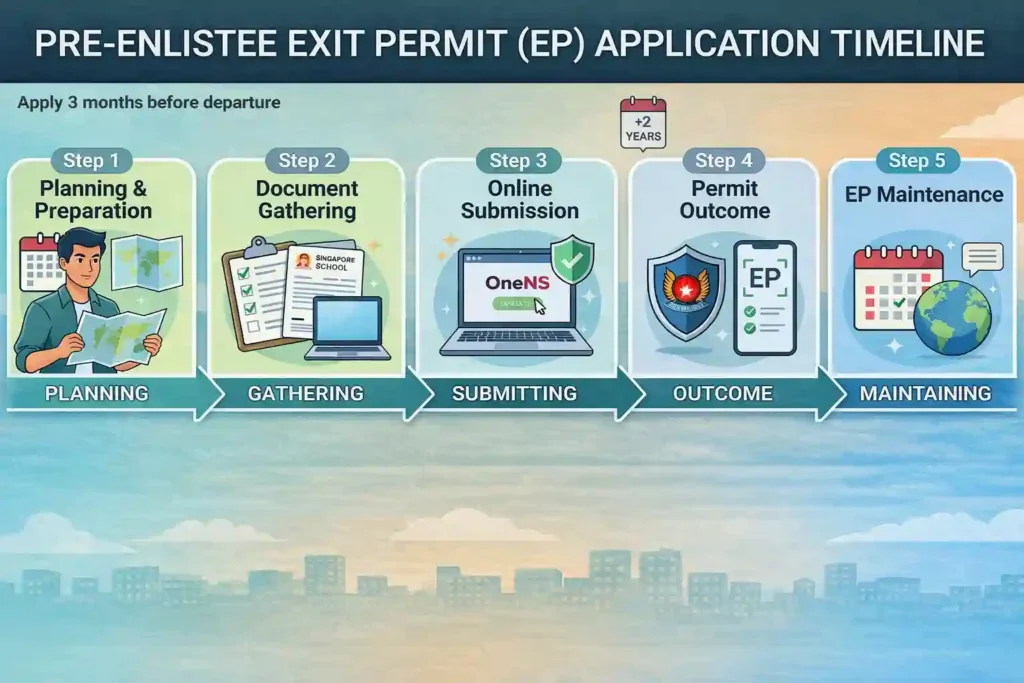
The official advice is to apply up to 3 months before departure. Treat that as the minimum, not the target. Bond applications involve income documents, banker’s guarantees, and potential back-and-forth with CMPB. If anything goes wrong administratively, you want time to fix it without panicking.
Documents you’ll typically need:
For overseas studies:
- School letter issued within the last 6 months, showing course level, start date, and end date
For bond applications:
- Latest Income Tax Assessment Notice for both parents
- Employment letters showing gross income if no tax notice is available
- Proof of overseas employment or business registration if applicable
- Copies of parents’ identity documents
Once approved, the EP is usually valid for up to 2 years or the length of your stay, whichever is shorter.
EP Timeline:
A few things that trip people up:
If your son’s place of study, course, or institution changes, apply for a new EP immediately. The old one becomes invalid. And if an EP expires while he’s overseas, he should apply for a new one on OneNS straight away. CMPB will follow up about any outstanding issues, but applying first is the right move. Sitting on it makes things much worse.
What NS Can Actually Do For Your Future
Here’s the version of NS most guys get: you serve your time, you ORD, you come back to civilian life wondering what just happened to two years. Maybe fit, and a bit more disciplined. But not much else to show for it on a resume.
That doesn’t have to be your story.
The government has built a set of learning opportunities into the NS framework. Most guys either don’t know they exist, or they find out about them during their last month and wish someone had told them earlier. Consider this that someone.
SkillsFuture@NS: 75,000 Courses
Once you enlist, you get access to the SkillsFuture@NS Learning eXperience Platform, known as the SF@NS LXP. Think of it as a Netflix-sized library, except instead of dramas, it’s courses. Over 75,000 of them, covering everything from coding to project management to finance to design.
It’s free. It’s available throughout your service. And most guys activate the account sometime in their last few weeks and barely scratch the surface.
The smarter move is to activate it in the first month and spend even two to three hours a week working through something useful. By the time you ORD, you could have a few legitimate certifications under your belt. The kind that actually show up well during university applications or job interviews.
Beyond the platform, there are 2 more things worth knowing:
SF@NS Career Fairs
It held in your last 3 to 6 months of full-time service. Employers and education institutions come to you. It’s a genuine networking opportunity that most guys treat as a free afternoon out. It’s more than that.
Employability Resilience Workshops
It cover resume writing, workplace communication, and networking. Useful if you haven’t had much working experience going in. Not compulsory, but worth attending.
You’ll receive instructions on how to activate your LXP account after enlistment. Don’t wait. Do it in week one.
Walk Out With a Diploma: The Work-Learn Schemes
This is the option that genuinely changes the trajectory for some guys, and it’s also the least talked about.
Under the MINDEF-SAF Work-Learn Schemes, you can apply to study for a diploma or earn partial university credits while serving. The commitment is up to 4 years total, which includes both your full-time NS and a Regular service period afterward. In return, MINDEF sponsors your diploma, and once you complete the full-time NS component, you start drawing a Regular service salary instead of the NSF allowance.
For the right person, someone who knows what field they want to go into and wants to come out of NS with something more than a fitness cert, this is worth serious consideration.
There are 8 schemes across the four services:
Service | Vocation | What You Get |
|---|---|---|
Army | Medic Specialists | Diploma |
Army | Army Technicians | Diploma |
Army | Supply Supervisors | Diploma |
Army | NSF Trainers | Partial university credits |
Navy | Naval Warfare System Specialists | Diploma |
Air Force | Air Force Technicians | Diploma or partial uni credits |
DIS | Cyber Specialists | Partial university credits |
DIS | Digital Specialists | Partial university credits |
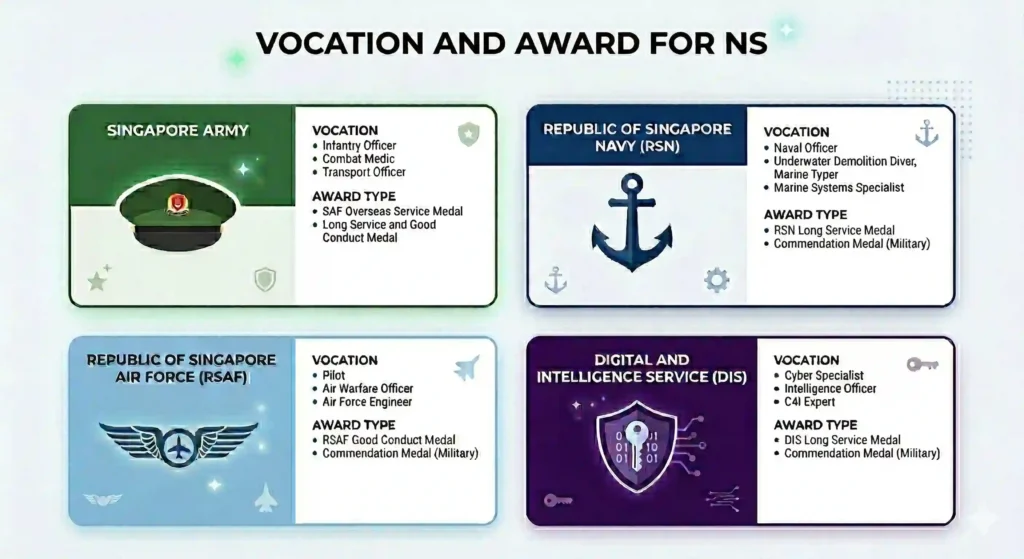
The two DIS schemes, Cyber Specialists and Digital Specialists, are worth highlighting separately. The Digital and Intelligence Service is relatively new, and both these vocations come with partial university credits rather than a diploma. If you’re heading into a tech-related degree, those credits can shave time off your university programme. The work itself is also genuinely relevant to the field in a way that some other NS vocations aren’t.
How to apply:
- Army schemes: Fill in the ARC Work Learn Scheme Application form at go.gov.sg/armywls, or call 1800 687 2769
- Navy: NRC Work Learn Scheme Interest Form at go.gov.sg/navywls, or call 1800 278 0000
- Air Force: AFRC Work Study Diploma Application Form at go.gov.sg/nsfwsdip, or call 1800 270 1010
- DIS: DIRC Work Learn Scheme Application Form at go.gov.sg/disworklearn, or email disworklearn@defence.gov.sg
Apply as early as possible. These schemes have limited spots, and demand has grown.
Poly Students: The Early Enlistment Option That Most People Ignore
If you’re a final-year polytechnic student, there’s a specific arrangement you may not know about.
MINDEF has partnered with local polytechnics to allow final-year diploma students to enlist a year early. The benefit is that your military service gets recognised toward your polytechnic’s final-year internship requirement. So instead of doing a standard internship and then enlisting, you do both at the same time, effectively saving yourself a step.
There are two structures:
Work-Learn Scheme (up to 4 years):
Available for DIS Polytechnic Cyber Specialists. You serve a combination of full-time NS and regular service for up to 4 years and come out with your diploma.
SAF-Polytechnic Sponsorship for Integrated Curriculum, known as SPS-IC (5 years, full regular service):
Currently available for Naval Warfare System Experts through the Navy, and Air Force Engineers (Maintenance) through the Air Force. This is a bigger commitment, but the SPS-IC comes with full regular service from the start.
If you’re in your final poly year and considering this, reach out early. The application windows aren’t particularly long, and competition for the DIS Cyber Specialist scheme specifically has been picking up.
Your Pre-Enlistee Checklist
Print this out. Stick it somewhere your mum will also see it.
Exit Permit side:
- Update your ICA mailing address. CMPB sends the EP notice there
- Know your 3-month trigger. Any overseas stay longer than that needs an EP
- Check whether a bond is required for your situation
- Start gathering income documents from both parents if a bond applies
- Apply on OneNS at least 3 months before departure
- Set a calendar reminder to renew the EP at least 2 months before it expires
- Cancel the EP within 3 months of start date if plans change
Learning opportunities side:
- Check eligibility for Work-Learn Schemes before enlisting
- Activate your SF@NS LXP account in week one, not week 100
- Block out the SF@NS Career Fair dates in your last 6 months
- Attend at least one Employability Workshop before ORD
Frequently Asked Questions (FAQ’s)?
Sources & References
This article is based on information from the following official Singapore government sources:
Exit Permit information sourced from the official LifeSG Pre-Enlistee Guide and the CMPB website. Learning opportunities sourced from the official LifeSG NS Learning Guide and the OneNS portal. Information was last verified April 2026.