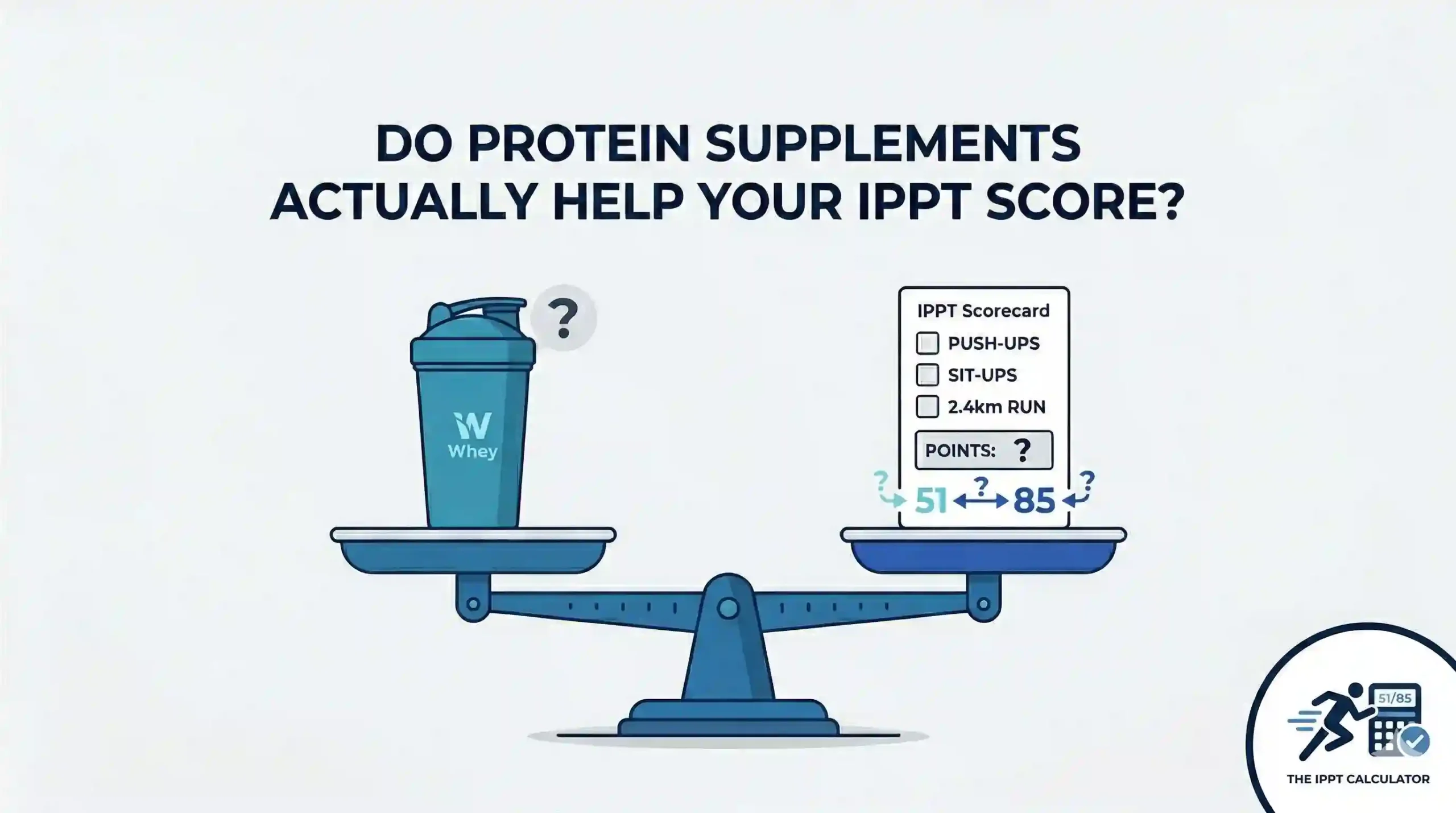
The Honest NSman’s Guide: Do Protein Supplements Actually Help Your IPPT Score?
This post contains affiliate links. If you buy through them, we may earn a small commission at no extra cost to you.
TL;DR: Protein supplements won’t magically make you run 2.4km faster, but they are the ultimate cheat code for surviving the muscle soreness of push-up and sit-up training so you can train consistently without wrecking your 40-year-old joints.
The Question I Get Asked Every Single Week
Every few weeks, a trainee pulls me aside at Maju FCC after a session and asks some version of the same question.
“Coach, I started taking whey protein. Will my push-up numbers go up?”
I have been coaching NSmen for 15 years. I have heard this question from 19-year-old pre-enlistees, and from 42-year-old NSmen who just failed IPPT for the second year running and are looking for a shortcut.
My answer is always the same. It depends. Not on the supplement. On you.
This guide is the full version of that answer. I am going to be direct with you because I think the fitness industry and some popular NS fitness forums do a poor job of this. They either hype supplements as game-changers or dismiss them entirely as a waste of money. Both positions are wrong.
First, Understand What IPPT Actually Demands From Your Body
Before we talk about protein, you need to understand what your body is doing during IPPT. This context matters because it determines whether any supplement is relevant at all.
The IPPT tests three things in under 90 minutes. Push-ups measure upper body muscular endurance. Sit-ups measure core endurance. The 2.4km run measures cardiovascular fitness and leg stamina.
Notice the word endurance appears twice before we even get to the run. IPPT is primarily an endurance test, not a strength or size test. This is the most important thing to understand before you spend a single dollar on supplements.
Protein helps your muscles repair and grow after training. It supports strength gains over time. But on test day itself, your score comes down to how well you trained over the previous 8 to 12 weeks. No supplement changes what happens once you are standing at the ELISS machine.
With that established, let us talk about when protein actually matters and when it does not.
Case Study 1: The Guy Who Spent $200 on Supplements and Got Worse
Shawn came to me in late 2022. He was 31, a software engineer, and had just failed IPPT with 48 points. Two points short of a pass. He was frustrated because he had been “training” for six weeks before the test.
When I asked about his training, he described 20 to 30 minutes of gym work three times a week, followed by a protein shake. He was spending around $80 a month on a tub of Myprotein Impact Whey and another $60 on creatine.
His actual push-up sessions lasted about 10 minutes. He had not run more than 1.5km in a single session since leaving full-time NS.
The supplements were not hurting him. But they were giving him a false sense of progress. He associated buying and consuming the products with “doing something about IPPT”. His training volume was nowhere near enough to trigger the adaptation he needed, and no amount of protein was going to close that gap.
We stripped the supplements out entirely. I put him on a structured 10-week plan with proper push-up progression, sit-up interval training, and three runs per week including one interval session. He passed his next IPPT with 63 points. He has not bought a protein supplement since and does not need to.
The lesson: Supplements do not replace training volume. Shawn’s problem was never nutrition. It was insufficient work.
When Protein Actually Does Help: The Three Real Scenarios
There are specific situations where adding protein to your diet can genuinely support your IPPT training. These are not marketing claims. These are patterns I have observed consistently across years of coaching.
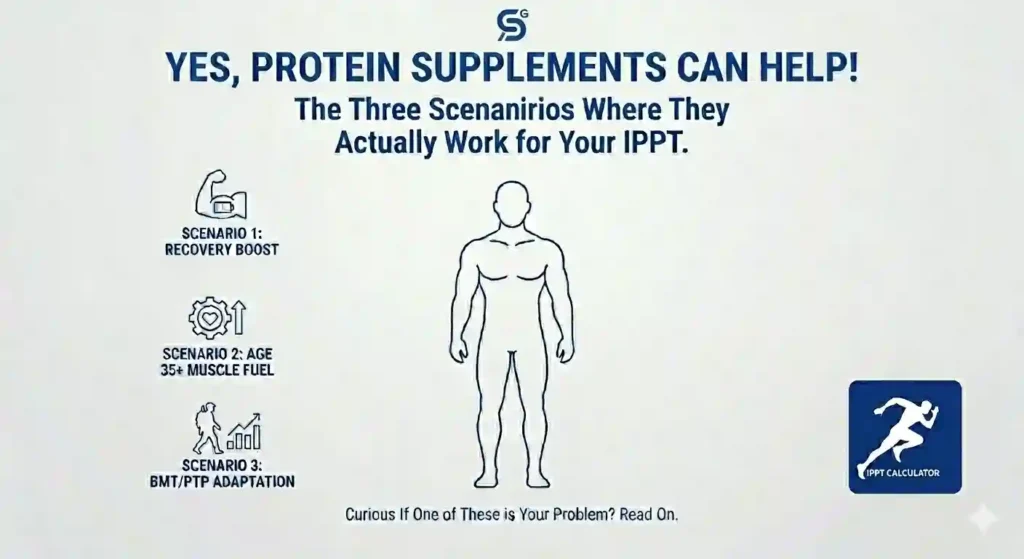
Scenario 1: You Are Train Hard but No Improvement
If you are doing push-up and sit-up sets 4 or more days a week and you are not improving, then it might be the issue with recovery. Muscles need fuels to rebuild, and if your diet is mostly carbs, i.e. rice, bread, noodles and not eggs, meat and lentils, your muscles are not getting enough fuel to rebuild between sessions.
So protein supplements is a must. It is filling a nutritional gap that your diet has left open. The supplement is doing the same job that a chicken breast or two eggs would do. It is just more convenient.
Scenario 2: You Are Past 35 and Building Fitness
After getting 35, synthesis of protein in muscles, slows down. This is not a myth. Your body becomes less efficient at using the protein you eat to build and repair muscle. Older NSmen need slightly more total protein per day to achieve the same muscle-building response as a 22-year-old eating the same amount. I work with a lot of men in the 38 to 45 age range. Many of them eat the same way they did at 25 but are surprised that they are not building back fitness as fast. Simply increasing how much protein you get every day, whether from food or supplements, is one of the few food based changes that actually makes a real difference for this group.
Scenario 3: A Pre-Enlistee Going Through PTP or BMT
Full-time National Service involves a dramatic increase in physical activity over a very short period. Pre-enlistees and NSFs in Basic Training are doing more physical work in a week than most of them have done in months or years. Their protein needs go up significantly during this phase.
This is the one scenario where I think a protein supplement makes the most practical sense. Cookhouse food is not always sufficient in protein quality or quantity. A simple whey shake after training sessions can meaningfully support recovery when you are doing PT twice a day.
The Honest Assessment of the Brands NSmen Actually Buy
I am not going to rank these by affiliate commission potential. I am going to tell you what I actually think based on what my trainees have used and reported back over the years.
Product | Best For | Where To Buy | Pros | Cons |
|---|---|---|---|---|
Optimum Nutrition Gold Standard | Serious trainees | High quality, easy mixing, no bloating | Expensive | |
Myprotein Impact Whey | Budget-Conscious | Very affordable, high protein content | Artificial sweeteners may cause bloating | |
Dymatize ISO100 | High-intensity athletes | Hydrolyzed for ultra-fast absorption | Overkill for most; very high price point | |
Now Foods Whey | Clean label seekers | Minimal additives and great value | Lesser-known brand; simple flavors | |
Muscletech Nitro-Tech | All-in-one users | Contains added creatine for convenience | Hard to control individual dosages | |
Plant Protein (Pea/Rice) | Vegan or Dairy-free | Lactose-friendly and animal-product free | Slightly less effective for muscle growth. |
Optimum Nutrition Gold Standard Whey
This is the most used brand among My trainees who are serious about their fitness. It mixes well, does not cause bloating for most people, and the protein quality is consistent. It is an expensive item, around SGD 80 to 100 for a 2kg tub. If you prefer to use whey, this is a reasonable choice. The taste is ok without much sweetness.
Myprotein Impact Whey
Popular because it is affordable, especially when bought during their frequent sales. The protein content per serving is solid. The downside is that a small number of my trainees have reported digestive discomfort, likely due to the artificial sweeteners. Buy a small sample bag before committing to a large tub.
Dymatize ISO100
A hydrolysed whey product that digests very fast. It is more expensive than standard whey. For most NSmen, the extra cost is not justified. Those who can do hard training or training twice a day, will be able to absorb it faster. As reservist also do some office job, it is very difficult for them.
Muscletech Nitro-Tech
I am cautious about recommending this one. It contains creatine blended into the protein. That is not necessarily bad, but it means you are paying for two products in one without controlling the dose of either. Better to buy them separately if you want both.
Now Foods Whey Protein
A lesser-known option that is genuinely good value. Minimal additives, decent protein profile. I suggest this one to trainees who want a clean product without paying a premium for marketing.
Unflavored pea or rice protein
Some of my trainees are unfortunately lactose intolerant, or animal lover, so prefer plant base protein. Pea protein from brands like Isopure works well. It is little less in leucine than whey, so it is less effective at triggering muscle protein synthesis, but the difference is small enough that it does not matter practically.
Case Study 2: The Pre-Enlistee Who Used Protein Correctly
In 2023, I was training some boys for pre-enlistment. One of them, a 19-year-old named Jun Wei, was underweight and struggled to recover between sessions, training consistently, but consistently feeling fatigued by day three of each training week.
We checked his diet. Breakfast was usually bread with kaya. Lunch was often cai png with mostly vegetables. Dinner was his best meal. His protein intake was around 50 g to 60 g per day. For someone doing 45 minutes of physical training six days a week, it was less than required
We added one scoop of Optimum Nutrition Gold Standard after training. That brought him to around 90 grams of daily protein without changing his meals dramatically. Within three weeks, his recovery was noticeable. His push-up numbers went from 28 to 36 in six weeks, which was contributed by both training progression and protein intake which ended the fatigued part from the sessions
Jun Wei did his pre-enlistee IPPT with 64 points and skipped PTP. The protein helped. But it helped because it fixed a genuine deficiency, not because it is magic.
Case Study 3: The 44-Year-Old Who Finally Passed After Three Years
Wei Jie had failed IPPT three years in a row when he came to me in 2021. He was 44, a sales manager, and was in average shape for his age. He had no exact exercised routine.
The problem was pretty straightforward, though frustratingly common. He was stuck in a rut because he wasn’t pushing his body hard enough, and he certainly wasn’t feeding it what it needed to recover. At 44, the “margin for error” disappears; your body demands a much louder alarm clock to wake up and build muscle than it did in your early twenties. You need more stimulus and more fuel, period.
We didn’t overcomplicate it. We just built a foundation that actually worked.
The strategy was a simple, structured split:
- Cardio: Three runs a week to build the engine.
- Strength: Two focused sessions targeting push-up and sit-up progressions.
- Nutrition: A tactical shift to include two extra protein-heavy meals every day.
To round it out, he threw in a protein shake on training days, which bumped his total daily intake to about 110 grams. After 12 weeks, Wei passed his IPPT with 61 points. It was not a Gold standard performance. But after three consecutive failures, passing felt significant. He has cleared it every year since.
The protein helped in his case specifically because his age made recovery harder and his diet had been inadequate. Without the training changes, the protein would have done nothing.
What the Research Actually Says (In Plain Language)
I am a coach, not a nutritionist, but I have spent enough time in field that I can see an evidence
Let’s be real: protein powder isn’t magic dust. It’s a tool, and like any tool, it only works if the foundation is already there. For a shake to actually do its job, triggering Muscle Protein Synthesis (MPS), you need two things firing at once, a consistent training stimulus and enough total daily protein.
The research on protein and cardiovascular performance, which is what your 2.4km run score depends on, is much weaker. Protein does not directly improve your aerobic capacity. Running improves your aerobic capacity. There is no shortcut here.
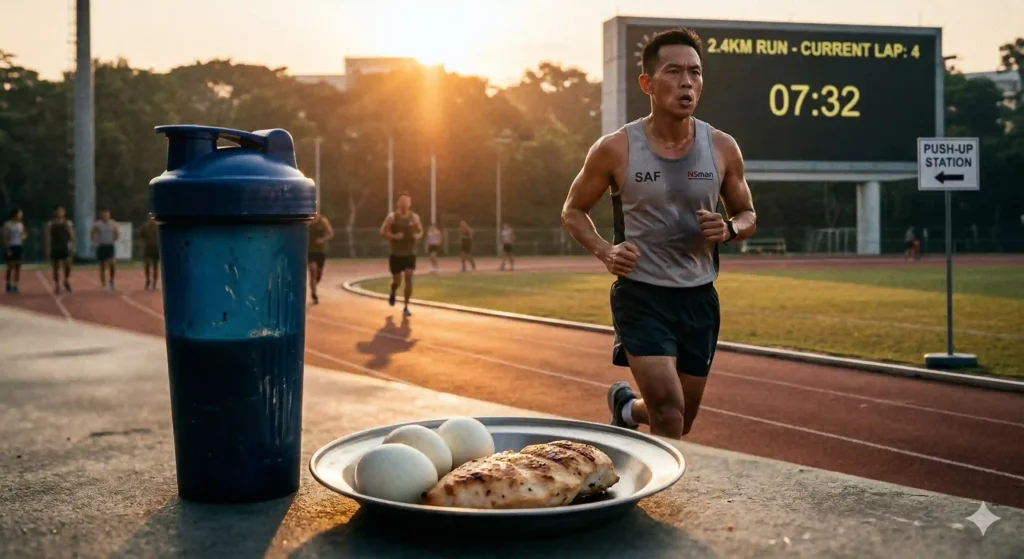
For the push-up and sit-up stations, the relationship is more relevant but if you are training regularly and eating enough protein, you will progress. The supplement is not the variable. Training frequency and quality are.
What to Actually Spend Your Money On Before Supplements
If you have SGD 80 to spend on improving your IPPT score, here is my honest order of priority.
A good pair of running shoes comes first. Running in old or inappropriate footwear actively works against you on the 2.4km. Something like the Asics Meta or Brooks Ghost in a neutral to stability category will make your training more comfortable and reduce injury risk. This has a more direct impact on your run timing than any supplement.
A pull-up or push-up bar for home training comes second. Being able to train at home removes every excuse about gym timing and access, and transforms your ability to train consistently.
A fitness tracker or basic running watch comes third. Knowing your 400m lap splits during training is the single biggest change most NSmen can make to their run preparation. You cannot pace yourself without data. A basic Garmin Forerunner or even a Smart Band or ring is enough to start.
Only after these physical tools would I consider directing money toward supplements.
My Honest Final Position
Protein supplements are a minor variable in IPPT preparation. They are not harmful for most people. They are not a waste of money if you have a genuine dietary gap. But they are wildly overrated as a performance tool for the vast majority of NSmen.
If you are taking proper meal, 2 times a day, that contain meat, eggs and lentils, plus your training and sleeping properly you do not need a protein supplement to improve your IPPT score.
If you are skipping meals, eating mostly Junk food or carb base food like bread and rice, training intensely, and noticing that you are consistently sore and not recovering, a protein supplement can help close that gap.
Stop asking which protein powder is the “best.” That’s the wrong question.
Instead, ask yourself this: “Am I actually training hard enough, and am I giving my body the fuel it needs to recover?”
If you’re honest about the answer, you’ll know exactly where your money should be going. One is a magic pill mindset; the other is a growth mindset. Choose the second one, and the results will follow.
Use the IPPT Calculator to see exactly where you are and how many more points you need in each station. The training gap is always more actionable than the nutrition gap. Start there.